
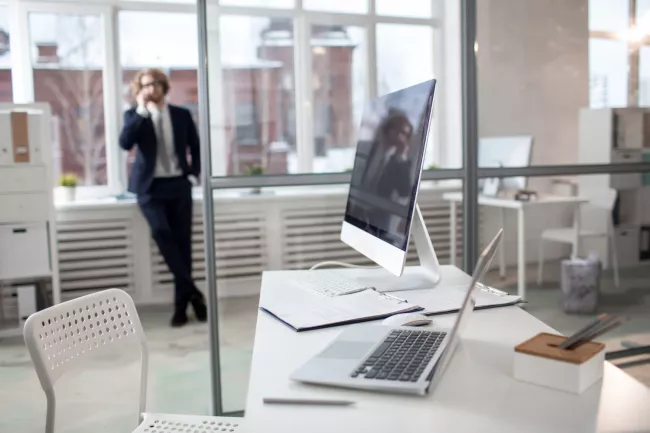
IT business has its own rules of the game, and the office here plays a much larger role than just a workplace. For a team of developers, stability, security, technological readiness of the space, and comfort are important, which directly affects productivity and retention of specialists. That's why an office for an IT company is usually chosen much more carefully than in many other industries.
In conditions of high competition for talent in the labor market, an office becomes not just a workspace, but a tool for attracting and retaining qualified specialists. Programmers, designers, project managers pay attention not only to salary and projects, but also to working conditions, office atmosphere, its location, and technical equipment.
Specifics of Office Rental for IT Companies
IT companies rarely look for a classic office format. Most often it's an open space with flexible zoning, meeting rooms, areas for teamwork and relaxation. Not only the area is important, but also how ready the premises are for quick changes, team scaling, new projects, or transitioning to a hybrid work format. Office rental for IT often involves long-term contracts, because relocations for technical teams are always stress and financial losses. Therefore, location and engineering characteristics must be relevant for the future.
Internet and Communication: Critical Infrastructure
Fiber optic internet is not an option, but a basic requirement. For most IT companies, it's important to have the ability to connect several providers simultaneously to avoid downtime. You should also pay attention to:
- availability of backup communication channels;
- speed stability during peak hours;
- ability to quickly scale the network;
- a ready server room or space for it.
An office for an IT company without reliable internet automatically drops out of the list of options, even if it's ideal in all other parameters.
The minimum internet speed for comfortable work of an IT team is 100 Mbps for every 10 employees. But for companies working with large volumes of data, video conferences, cloud services, or streaming, this figure should be much higher. Some companies rent dedicated channels with guaranteed speeds of 500 Mbps or even 1 Gbps.
The quality of internal network infrastructure is also critically important. The business center must be equipped with a structured cabling system, a sufficient number of network points, powerful switches, and the ability to configure its own local network with the necessary level of security.
Uninterruptible Power Supply and Autonomy
The issue of power supply is especially painful for the IT sector. Modern offices for programmers must be equipped with:
- backup power supply lines;
- diesel or gas generators;
- UPS systems for servers and network equipment;
- stable power without voltage fluctuations.
The presence of autonomous electricity often becomes a key argument when choosing an office, even if the rent costs more than the market average.
In conditions of unstable power supply, which has especially worsened in recent years, IT companies are willing to overpay 15-25% for an office with a reliable autonomous system. This is not wasteful spending, but a rational investment: one hour of developer downtime can cost the company much more than the difference in rent.
It's important to understand that the generator must not just be in the building, but be properly configured with automatic switching. A 5-10 second delay when switching to backup power can be critical for server equipment. That's why quality business centers install uninterruptible power supply (UPS) systems that ensure seamless transition to the generator.
It's also worth clarifying the generator's capacity and its continuous operation time. Some business centers have generators designed only to support elevators, lighting, and basic systems, but insufficient for full operation of all tenants simultaneously. If your company consumes a significant amount of electricity (servers, large number of computers, air conditioning system), this issue needs to be clarified in advance.
Security and 24/7 Access
IT companies often work with confidential data, international clients, and non-standard schedules. Therefore, it's important to have:
- 24-hour security of the business center;
- access control (cards, turnstiles, floor security);
- video surveillance;
- ability to work 24/7 without restrictions.
These factors are especially relevant for companies with global teams and night shifts.
Security for IT companies is not only physical protection of premises, but also protection of data and intellectual property. Therefore, it's important that the business center has a modern access control system with the ability to differentiate rights for different employees, maintain a visitor log, and quickly block access when an employee is terminated.
For companies working with confidential information or obliged to comply with international security standards (ISO, SOC 2, GDPR), such aspects as the availability of certified security systems, the ability to install additional controls, separate server rooms with increased protection are important.
If the team works 24/7 or has employees in different time zones, unhindered access to the office around the clock is needed, including weekends and holidays. Not all business centers support this: some restrict access after a certain hour or on weekends, which can be a critical limitation.
Space Planning: From Open Space to Phone Booths
Modern IT offices require thoughtful zoning. In addition to workplaces, you need:
Meeting rooms of different sizes — for teams of 4-6 people, large presentations for 10-15 participants, private one-on-one meetings. Sound insulation, quality screens for video conferences, fast internet are important.
Phone booths or quiet zones — small private booths for calls or focused work. In open space, there's often not enough silence, and such zones become a necessity.
Recreation areas — not just a sofa in the corner, but a comfortable space with the ability to switch, drink coffee, play board games, or just rest between complex tasks.
Kitchen or dining area — important for teams that spend a lot of time in the office. Refrigerator, microwave, dishwasher, coffee machine are a basic set without which it's hard to imagine a modern IT office.
Event space — for hackathons, internal conferences, client meetings, or just Friday get-togethers with the whole team.
Planning flexibility allows adapting the office to changing needs without major renovation. Mobile partitions, transformable furniture, modular zoning systems — all this makes the space alive and able to change with the company.
Coworking for Programmers and Startups
For startups and small IT teams, coworking for programmers often becomes an ideal solution. It allows you to start quickly without large investments in renovation and infrastructure.
Advantages of coworking for the IT sphere:
- ready technical infrastructure;
- flexible rental conditions;
- ability to scale;
- networking and community access;
- meeting rooms and event zones.
For many companies, coworking becomes a transitional stage before renting a separate office.
Coworking spaces are especially convenient for startups in early stages, when the team is still forming and it's hard to predict growth rates. Instead of signing a long-term rental agreement for 50 sq.m., you can rent 5 workstations in a coworking space, and in three months expand to 10 or, conversely, reduce to 3.
Another advantage of coworking is a ready ecosystem. In quality coworking spaces, events, meetings, master classes are often held, which gives an opportunity to meet other teams, find partners, investors, or just exchange experiences.
At the same time, coworking spaces have their limitations. Open space means less privacy, which can be a problem for confidential calls or discussions. Also, coworking spaces usually have fewer opportunities for branding and creating your own corporate culture.
Rental Cost: What Affects the Price
The cost of renting an office for an IT company can vary significantly depending on location, building class, and technical equipment.
The price is affected by:
- business center class (A, B, C);
- area and transport accessibility;
- availability of autonomous electricity and generator;
- quality of internet connection;
- condition of premises (finished or needs renovation);
- parking availability;
- additional services (cleaning, security, reception).
It's important to consider not only the basic rental rate, but also all related costs: utilities, operating costs, parking, internet. Sometimes an office with a lower basic rate turns out to be more expensive due to high utilities or the need for additional renovation investments.
What Else to Pay Attention to When Choosing an Office
In addition to basic technical requirements, IT companies often consider:
Space branding capability — for many companies it's important to create a unique atmosphere with their own branding, colors, corporate style elements. Not all landlords allow significant changes in decoration.
Availability of shelter or safe zone — in modern realities this can be an important factor, especially for companies that care about employee safety.
Developed infrastructure nearby — cafes, restaurants, gyms, banks, pharmacies, shops. If there's no basic infrastructure around the office, it reduces its attractiveness.
Landlord flexibility regarding redevelopment — ability to quickly adapt the space to changes in the team or business processes without lengthy approvals.
Ecology and air quality — ventilation systems, air conditioning, ability to open windows, presence of green zones. For teams that spend 8-10 hours in the office, air quality is critically important for health and productivity.
Ability to keep pets — some IT companies practice pet-friendly offices, which becomes an additional plus for employees with pets.
The office should not just be functional, but an attractive place where you want to come to work. In conditions of competition for talent, this becomes a competitive advantage.
Rental Agreement: Specifics for IT Companies
When concluding a rental agreement, IT companies should pay attention to several specific points:
- clear guarantees regarding the quality and stability of internet connection with the possibility of compensation or rent reduction during outages;
- electricity usage conditions and guarantees of autonomous system operation;
- ability to install additional equipment (server cabinets, cooling systems, additional switches);
- scaling conditions — what happens if the team grows and additional space is needed;
- early termination conditions if there's a need to quickly cut costs.
It's also worth providing for the possibility of subletting if the company decides to rent part of the office to another team or use it as coworking.
Conclusion
Office rental for IT companies is a balance between technology, security, comfort, and location. Reliable internet, uninterruptible electricity, security, and space flexibility are basic things without which a modern IT office is impossible.
A properly selected office or coworking for programmers becomes not an expense, but an investment in business stability and team satisfaction. In conditions where talented IT specialists can choose work in any company in the world, the office becomes an important part of employee experience and a tool for team retention.
Don't save on critical things: quality internet, reliable electricity, security. At the same time, it's not necessary to rent the most expensive office in the center if your team values other things. The main thing is to find a balance between business needs, team expectations, and the company's financial capabilities.
FAQ
What office is best suited for an IT company? Offices with open space, stable fiber optic internet, backup electricity, and 24/7 operation capability are best suited.
Is it worth choosing coworking for programmers? Yes, for startups and small teams it's a convenient and economically viable option with ready infrastructure.
How important is autonomous electricity for an IT office? Critically important. Without a generator or backup lines, any failure can stop the team's work.
Which districts of Kyiv are best for IT office rental? Popular are the center, Podil, Pechersk, Shuliavka, and areas near major transport hubs.
Can an office be adapted to IT team needs? Yes, but this needs to be agreed upon in advance with the landlord and fixed in the contract.