
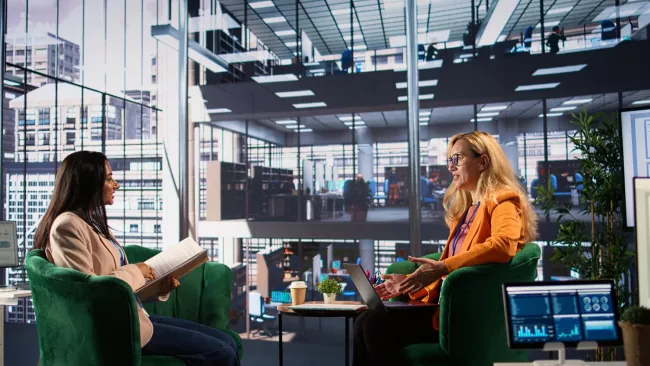
The year 2026 is shaping a new logic for the office real estate market. Companies are no longer searching for “just office space” — they are looking for a tool to manage costs, risks, and team efficiency. After years of instability, war-related risks, hybrid work models, and economic fluctuations, businesses have become significantly more pragmatic.
Today, an office is not a symbol of status but part of a company’s operational model. This shift defines the new requirements tenants have in 2026.
1. Smaller Spaces — Rational Planning Instead of “Growth Reserves”
A few years ago, companies tended to lease extra space in anticipation of future growth. In 2026, this approach has largely disappeared. Businesses now focus on actual headcount and real office attendance patterns.
The reduction in leased space is driven by:
- hybrid work models;
- partial remote employment;
- the need to optimize fixed costs;
- more flexible team structures.
However, smaller space does not mean lower quality. On the contrary, companies pay greater attention to layout efficiency and functionality. They analyze workspace utilization, use desk-booking and meeting-room management systems, and track attendance patterns across the week. The office is no longer a static asset — it becomes a managed resource that adapts to team behavior.
This data-driven approach helps avoid unnecessary costs while maintaining operational effectiveness.
2. Flexible Lease Agreements — Minimizing Long-Term Risks
In 2026, companies avoid rigid long-term leases without adjustment options. Economic uncertainty, workforce changes, and evolving business models push tenants to build flexibility into their agreements.
The most demanded formats include:
- leases with early termination options;
- expansion or reduction rights;
- market-based rent review mechanisms;
- shorter lease terms with extension options.
A lease agreement is no longer viewed solely as a legal document but as a risk management instrument. Companies assess it based on flexibility, financial consequences, and the ability to adapt quickly to change. Business centers that are willing to negotiate and tailor conditions gain a clear competitive advantage.
3. Infrastructure Over Image
Priorities have shifted from prestige and aesthetics to functionality and reliability. Designer lobbies, iconic facades, and visual appeal are no longer decisive factors.
Instead, companies focus on:
- the presence and readiness of shelters;
- backup power systems;
- stable internet connectivity;
- convenient transportation access;
- surrounding infrastructure.
This reflects a broader cultural shift: businesses prioritize reliability over prestige. Some companies are willing to consider less “prime” or less visually impressive locations if they offer better logistics and lower total occupancy costs.
4. Safety as a New Standard
Safety has moved from being a competitive advantage to a mandatory requirement. The presence of shelters, backup power, and clearly defined emergency procedures has become a baseline expectation.
In 2026, tenants evaluate:
- real accessibility of shelters;
- building autonomy and backup systems;
- emergency notification systems;
- crisis management preparedness of the property management.
Importantly, companies assess safety in a systemic way. They look not only at the existence of equipment but also at operational processes: who coordinates during emergencies, how communication with tenants is handled, and whether clear response scenarios are in place. Structured safety management has become a key indicator of a high-quality business center.
5. The Office as a Collaboration Hub, Not a “Seat Allocation”
Hybrid work has redefined the purpose of the office. It is no longer a place where every employee has a permanently assigned desk. Instead, the office becomes a space for:
- team collaboration;
- strategic sessions;
- client meetings;
- strengthening corporate culture.
This changes space planning. The number of fixed workstations decreases, while meeting rooms, flexible zones, and shared spaces increase. Companies rethink the office as a platform for synergy rather than a location for individual daily work.
6. Budget Rationalization and Full Cost Control
In 2026, tenants evaluate not only base rent but the full cost of occupancy. The focus includes:
- operating expenses (OPEX);
- utility costs;
- indexation clauses;
- fit-out and adaptation costs;
- long-term financial commitments.
Companies increasingly apply the Total Occupancy Cost approach — assessing the full financial impact of occupying office space over the lease term. This enables strategic decision-making rather than relying solely on a seemingly attractive rental rate.
Budget rationalization does not mean cutting costs at any price. It means ensuring predictability and controllability of expenses.
Conclusion
In 2026, office requirements have become significantly more pragmatic. Businesses prioritize:
- compact and efficient spaces;
- flexible lease terms;
- functional infrastructure;
- systematic safety standards;
- controlled total occupancy costs.
The office is no longer a status symbol. It is a management tool for efficiency, risk mitigation, and resource optimization.
FAQ
Why are companies reducing office space in 2026?
Due to hybrid work models and the need to optimize fixed costs while maintaining efficiency.
What types of lease agreements are most popular in 2026?
Flexible leases with early termination options and space adjustment rights.
Is the prestige of a business center still important?
Yes, but functionality, safety, and cost control now take priority.
What are the main office selection criteria in 2026?
Safety, building autonomy, lease flexibility, and total cost management.